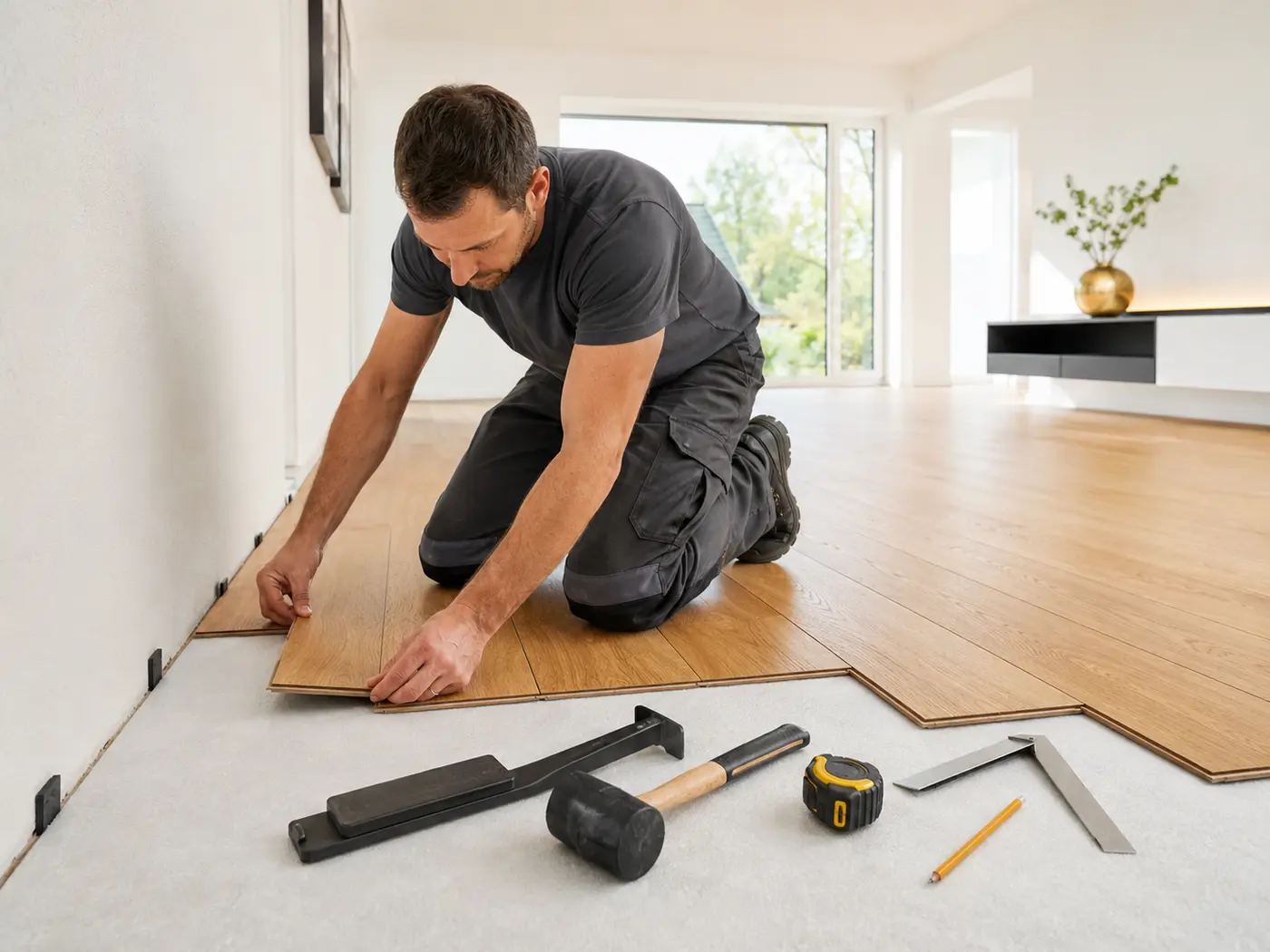
Two installation methods with different build-ups
This comparison covers floating click vinyl and vinyl fully bonded to the subfloor. In the first, the elements connect to one another; in the second, the covering is glued to the prepared substrate. Systems with self-adhesive underlay are a separate option and should be named explicitly in a quote.
Start by asking for the manufacturer, collection and product code. The word vinyl alone does not identify the proposed system. For the broader choice between laminate, vinyl and prefinished parquet, use our separate overview.
| Point | Floating click vinyl | Fully bonded vinyl | Ask the contractor |
|---|---|---|---|
| Subfloor | Flatness and stability to product requirements | A surface compatible with the adhesive system as well | What preparation is included? |
| Finished height | Flooring plus its specified underlay | Flooring, adhesive and preparation layers | What will the final surface height be? |
| Underlay | Separate or integrated, depending on the product | No loose click-floor underlay in a directly bonded system | Which build-up is approved? |
| Fixed units | Check movement allowance and perimeter gaps | Plan connections and joints for the system | How are kitchen units and doorways handled? |
| First use | No floor adhesive to cure | Loading follows the adhesive system's instructions | When can furniture enter the room? |
| Repairs | Check the method for the specific locking system | Check replacement and work on the bonding surface | How can an individual element be replaced? |
The existing subfloor affects the choice
A click system still needs a suitable subfloor. Quick-Step specifies different flatness requirements for Alpha Vinyl and glued Vinyl Flex; tile joints must be smoothed for Vinyl Flex. Approval for one product therefore cannot be applied to every vinyl floor.
Have both options assessed against the same starting conditions: existing layers, moisture, cracks and loose areas. Ask which checks remain open and what work they could lead to. A photo and an impression that the floor looks flat are not enough to confirm the build-up.
Consider finished height and underlay together
Compare the final surface height at doors, transitions and appliance recesses. Plank thickness is only one part of it. Ask the contractor for a short layer-by-layer description of each option, including preparation. This makes any work at adjoining surfaces easier to identify.
An extra underlay is not automatically an improvement. For example, Quick-Step does not allow one beneath Alpha Vinyl Pad, which already has an integrated underlay. Ask which combination your product requires; do not assume an existing laminate underlay can be reused.
Agree installation and furniture dates separately
Floating installation removes the need for floor adhesive to cure. Preparation and acclimatisation can still take time. Glued vinyl also depends on the adhesive system being ready for use: the Quick-Step Vinyl Flex instructions distinguish careful walking from loading the floor with furniture.
Confirm three dates: preparation starts, installation finishes and the floor is released for its intended use. Also ask who will communicate that release. A short installation slot is little help if a wardrobe or the next contractor arrives too early.
Identify fixed units and underfloor heating before choosing
Mark kitchen islands, fitted cupboards and other fixed elements on the room plan. The Alpha Vinyl Pad instructions require the floating floor to remain free to move, without being blocked by such units. Edges, doorways and connections must be planned for the selected system.
With underfloor heating, check approval for the complete build-up. Quick-Step distinguishes glued and floating options, including their underlays. Ask the contractor for the documents matching your heating system; a general suitable-for-underfloor-heating label does not establish that match.
Separate repair from eventual removal
Replacing one damaged plank differs from removing the entire floor. Quick-Step describes a specific replacement procedure for click vinyl. This does not promise that every element can simply be unclicked at any time. Before buying, ask about the method for your product and matching spare material.
For removal of glued vinyl, Tarkett describes detaching the covering and removing adhesive residue. Clarify the likely work if a future floor change matters to you. With click vinyl, also consider any preparation that alters the original floor.
Compare two quotes on the same basis
If both systems are viable, request options for the same rooms and subfloor condition. Compare the full scope rather than just the flooring or installation price. A thinner plank or a faster joint alone does not determine the work involved.
- Name the exact product and installation method, including every additional layer.
- List assessment, preparation and work that cannot yet be priced separately.
- Record finished height and adjustments at doors and transitions.
- Identify fixed units, underfloor heating and other special use conditions.
- Confirm installation and permission to move furniture in separately.
- Discuss spare material, repair methods and any future removal plans.
Send a useful enquiry through HandMen
Describe the rooms, approximate area, existing flooring, intended use and move-in date. If you have shortlisted products, give their exact names. Ask the executing contractor to assess which option suits the existing conditions.
HandMen handles online marketing and enquiry referrals. Before forwarding personal data, we name the specific independent partner and obtain your separate consent. You arrange the quote, contract, technical assessment, work, invoice and payment directly with that business. HandMen does not carry out flooring work.