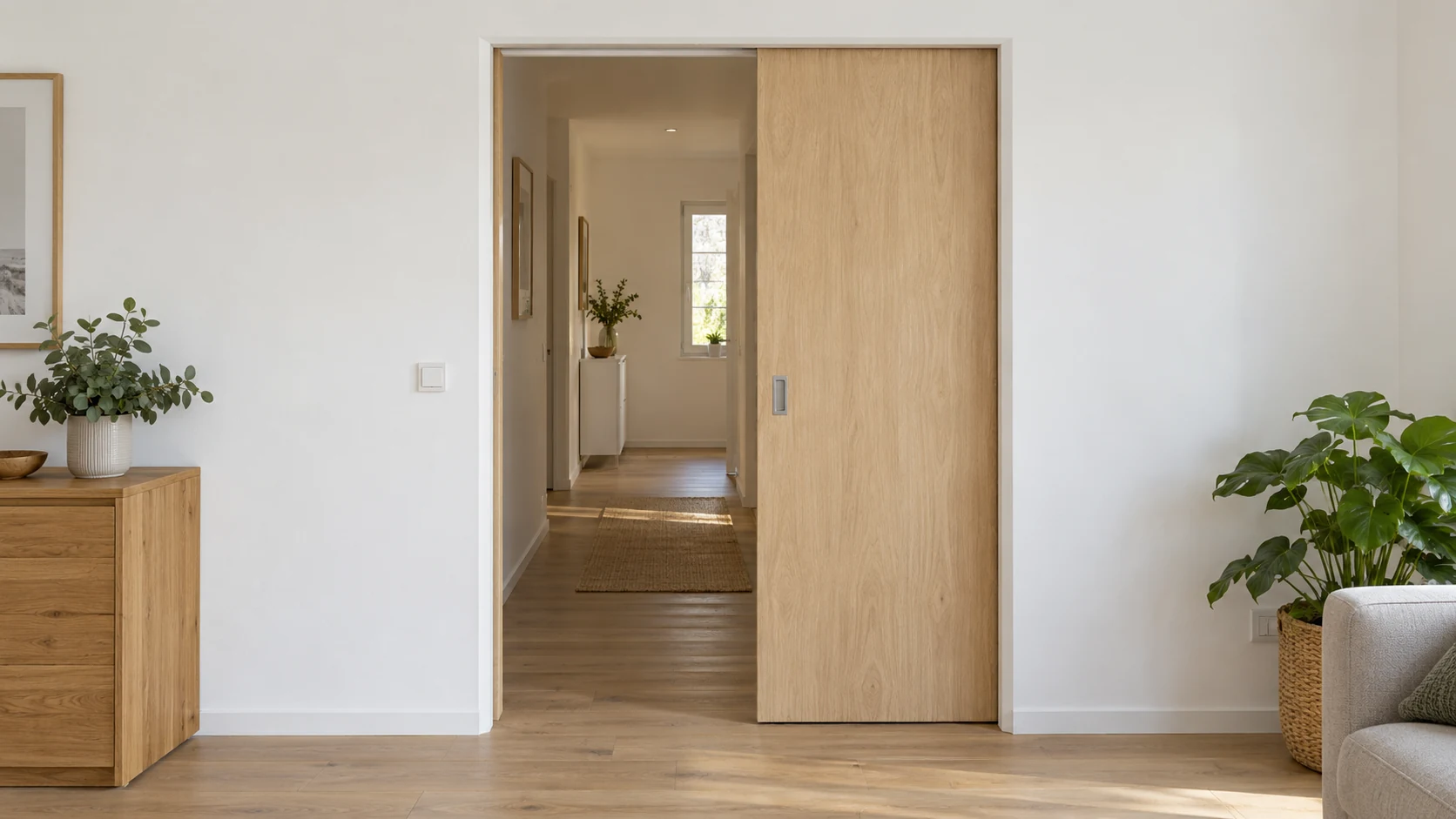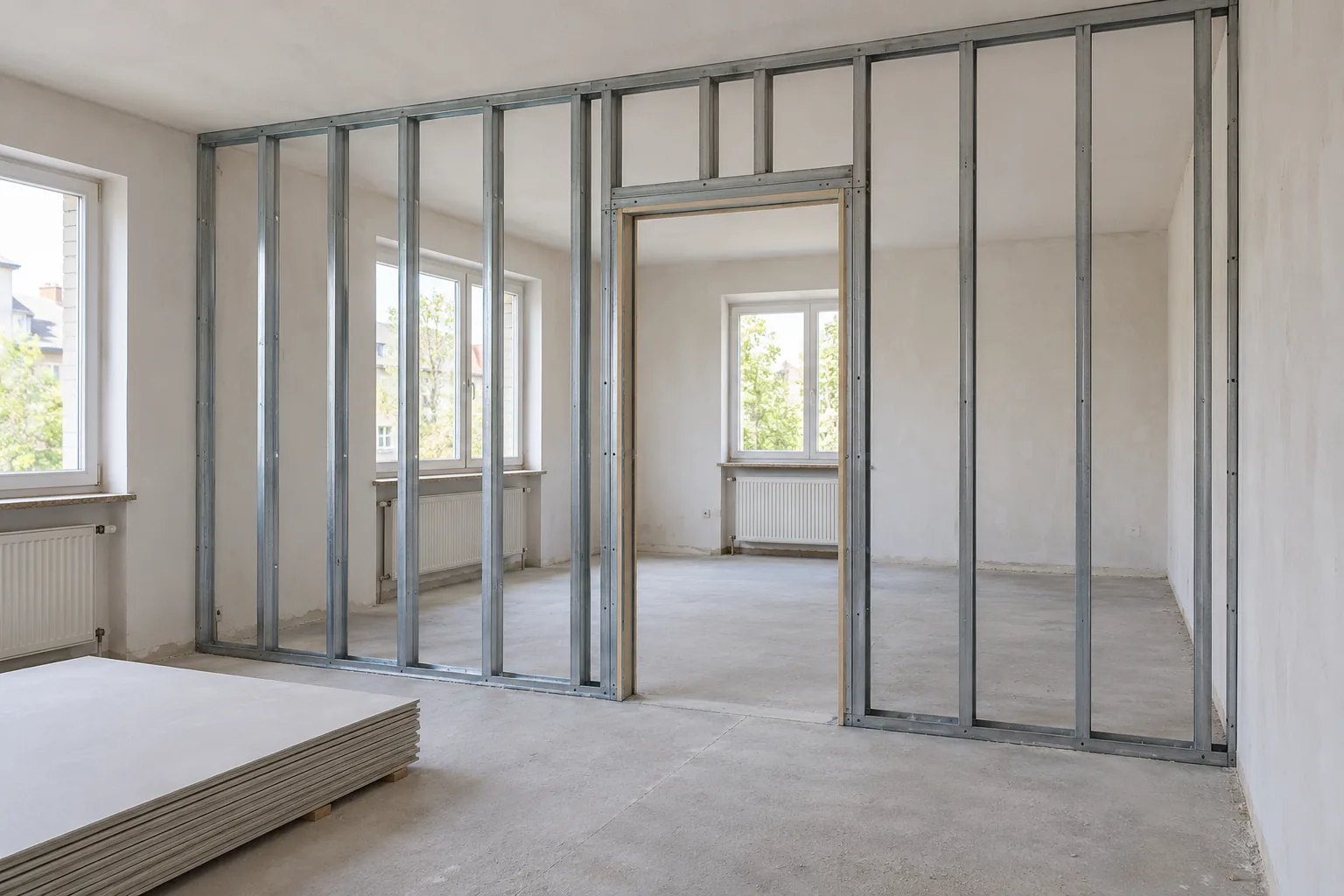
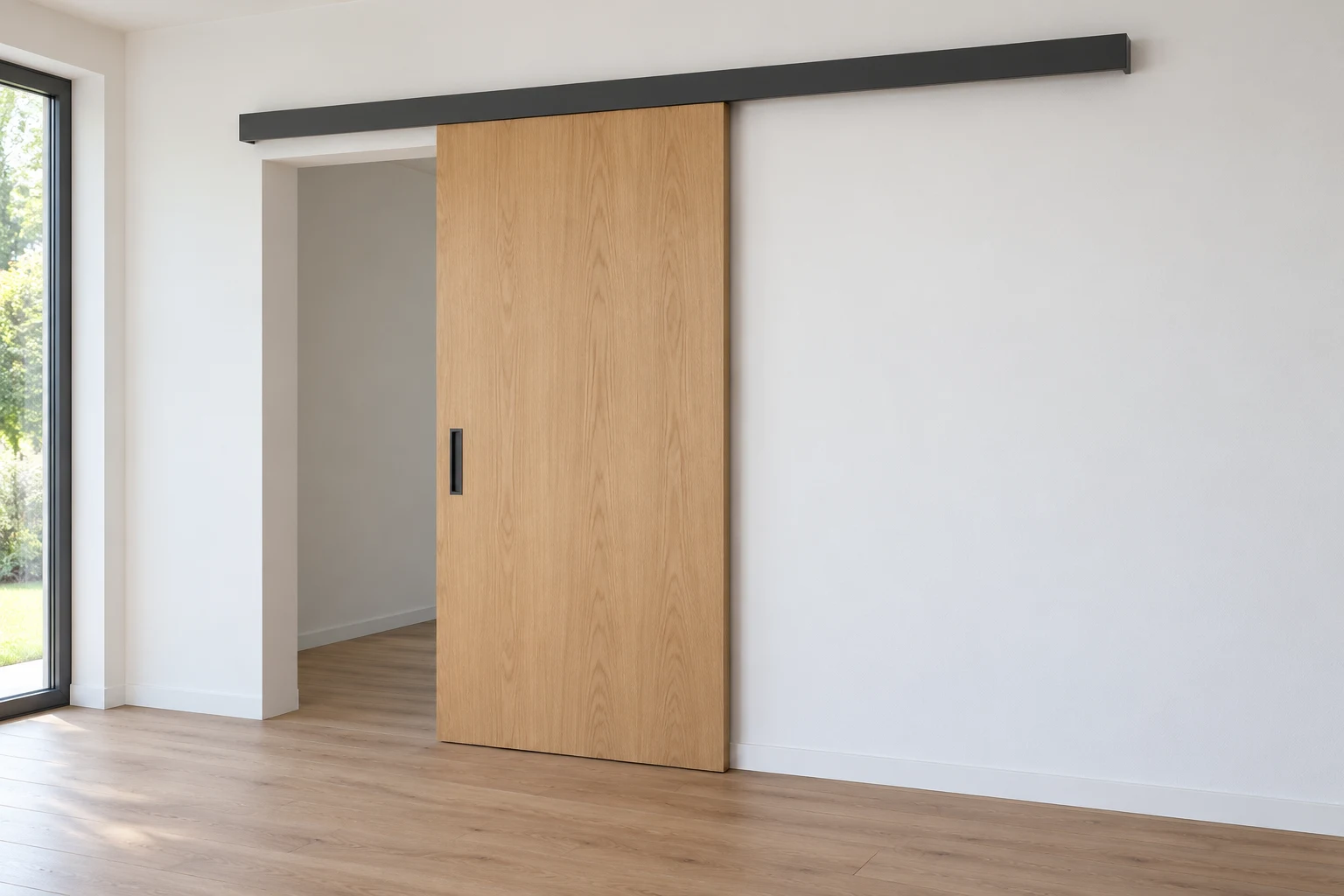
Beside the wall, not inside it
A surface-mounted sliding door does not disappear into a wall pocket when opened. Its leaf moves along an exposed wall surface. This changes the planning question: the clear travel zone, the track and its connection to the existing construction matter, rather than only a concealed cavity.
HandMen refers enquiries from Idstein, Wiesbaden and the Rhein-Main region to independent contractors. This guide helps prepare an enquiry involving a non-load-bearing drywall partition. It does not confirm the suitability of an existing wall or a particular fixing. A separate pocket-door guide covers doors that slide inside the wall.
Describe the intended use first
Explain which spaces the door should separate and how it will be used in daily life. Is the aim mainly a visual division, a frequently used passage or another requirement? State the intended result before treating an attractive door photograph as evidence that a proposal is suitable.
A closed leaf alone does not establish particular acoustic, smoke or fire protection. Accessibility, locking and special use requirements are separate planning questions too. Where these apply, the responsible professionals must assess them. This article does not replace required project design or declare a proposed alteration permissible.
Separate the wall information from the door system
Collect available wall documents and information about the intended door leaf. Unknown board layers, framing or reinforcement must remain explicitly unknown. A surface photograph can show the visible arrangement, but cannot prove the concealed construction or its suitability for supporting a track.
GEZE identifies leaf weight, material and application location among the criteria for selecting fittings. That does not approve any particular drywall partition. The appointed contractor must assess the door system, fixing substrate and necessary preparation together. Ceiling mounting is not an unchecked fallback either. No anchors, spacings or load values are recommended here.
Draw the full travel path
Sketch the door both closed and open. Mark the intended passage, the area beside the opening and existing obstructions. An empty-looking wall is not automatically an unobstructed travel zone: skirting, handles, switches, sockets and nearby furniture may all need coordination.
Preliminary dimensions serve only the enquiry. Final surveying must account for the finished floor, finished surfaces and the actual selected system. The question is not simply whether the leaf fits a wall drawing, but whether it can be operated in the intended arrangement while necessary areas remain accessible.
| Item | Record for coordination |
|---|---|
| Use | Intended division and special requirements |
| Wall | Known documents; leave unknown construction open |
| Door | Proposed leaf and available product information |
| Travel | Sketch both closed and open positions |
| Surroundings | Skirting, switches, sockets, furniture and nearby doors |
| Finished dimensions | Floor and surfaces for the final survey |
Assign follow-on work before ordering
If the wall needs preparation or additions, agree the sequence between drywall work, door installation and finishing. A track purchased later must not be assumed compatible with an already closed construction. Changes to the plan should go back to the people involved before an order is placed.
Identify existing electrical installations and other fittings that could be affected. Any necessary relocation is a separate specialist task to clarify. Also record who reinstates openings or added surfaces and what finish is included. An installed leaf alone does not describe these adjoining tasks.
Consider operation and future access
Discuss the sides from which the door will be operated, the proposed handles and how the area will be used with the leaf open. Furniture should not reveal only after installation that the planned travel zone is needed for daily activities. Access to nearby controls belongs on the shared sketch too.
Cleaning, adjustment and possible servicing require the selected system’s information. A decorative cover must not block necessary access without assessment. Ask for the intended operating and care information at handover; this is not a general instruction to dismantle the door yourself or alter its fixings.
Prepare a comparable quotation
A useful quotation separates assessment, design, wall preparation, the door system, installation and adjoining work. Clarify who owns each item and which prerequisites remain unresolved. Two prices are not meaningfully comparable if one covers only door fitting while the other includes additional wall work.
Record changes in writing, particularly a different leaf, track or floor build-up. A previously discussed detail does not automatically apply to every replacement product. Final technical specification remains with the appointed contractor and any other responsible professionals involved.
| Task | Clarify responsibility |
|---|---|
| Existing conditions | Who assesses the wall and possible fixing zones? |
| System selection | Who coordinates the leaf, fittings and requirements? |
| Preparation | Who designs and provides necessary wall additions? |
| Installations | Who clarifies affected services and specialist tasks? |
| Installation and finish | Who handles the door, interfaces and surfaces? |
| Handover | Which operating documents and open points are recorded? |
Request a referral with open questions visible
For an initial enquiry, provide the location, overview photographs, available documents and a sketch showing intended use and travel. Label assumptions. An enquiry can support the search for an appropriate independent contractor, but is not confirmation of feasibility or availability.
HandMen does not carry out construction work or grant technical approval. The specific independent partner is named and your separate consent obtained before personal contact details are passed on. You arrange the inspection, quotation, contract, work, invoice and payment directly with that business. HandMen remains responsible for its own referral tasks.