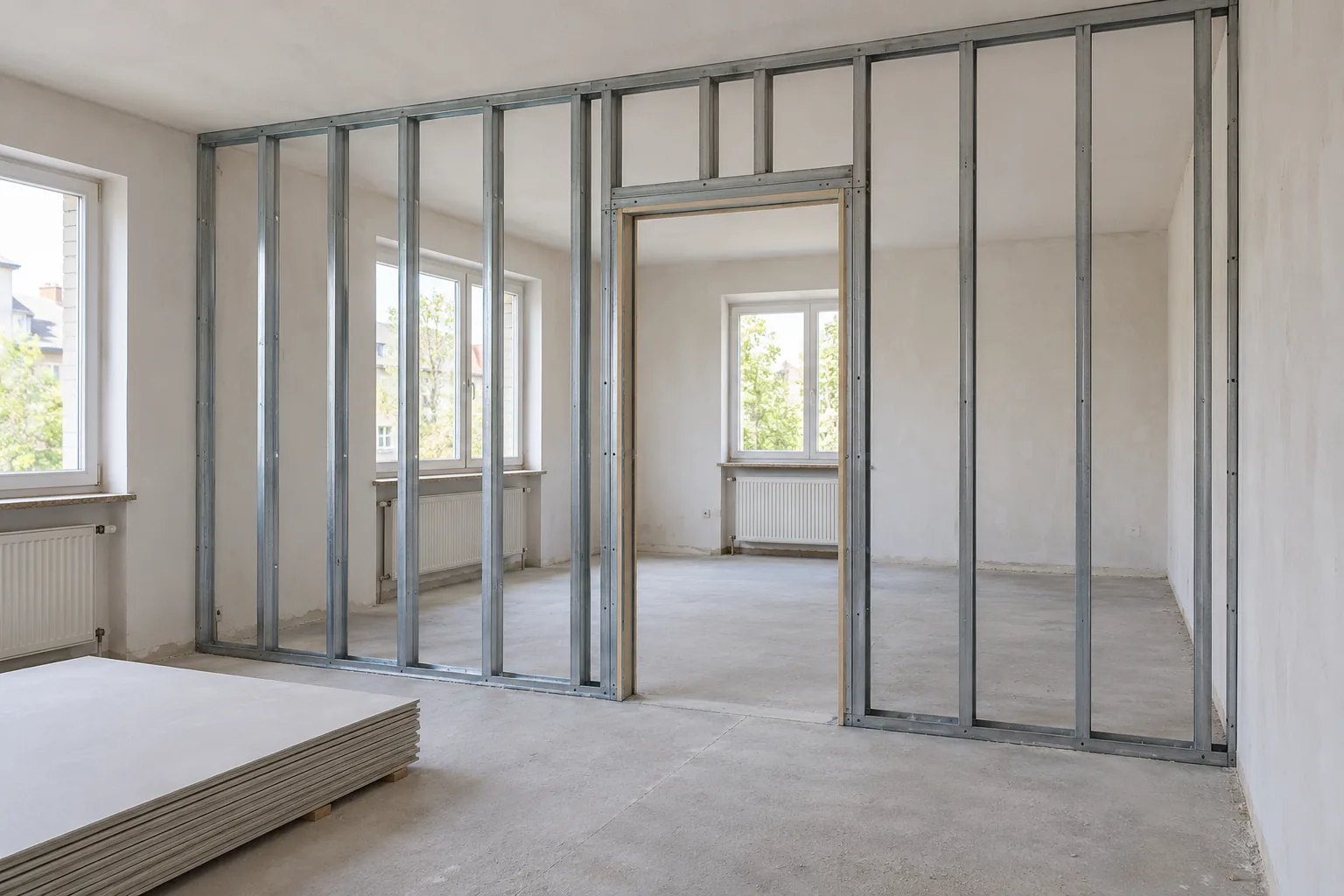
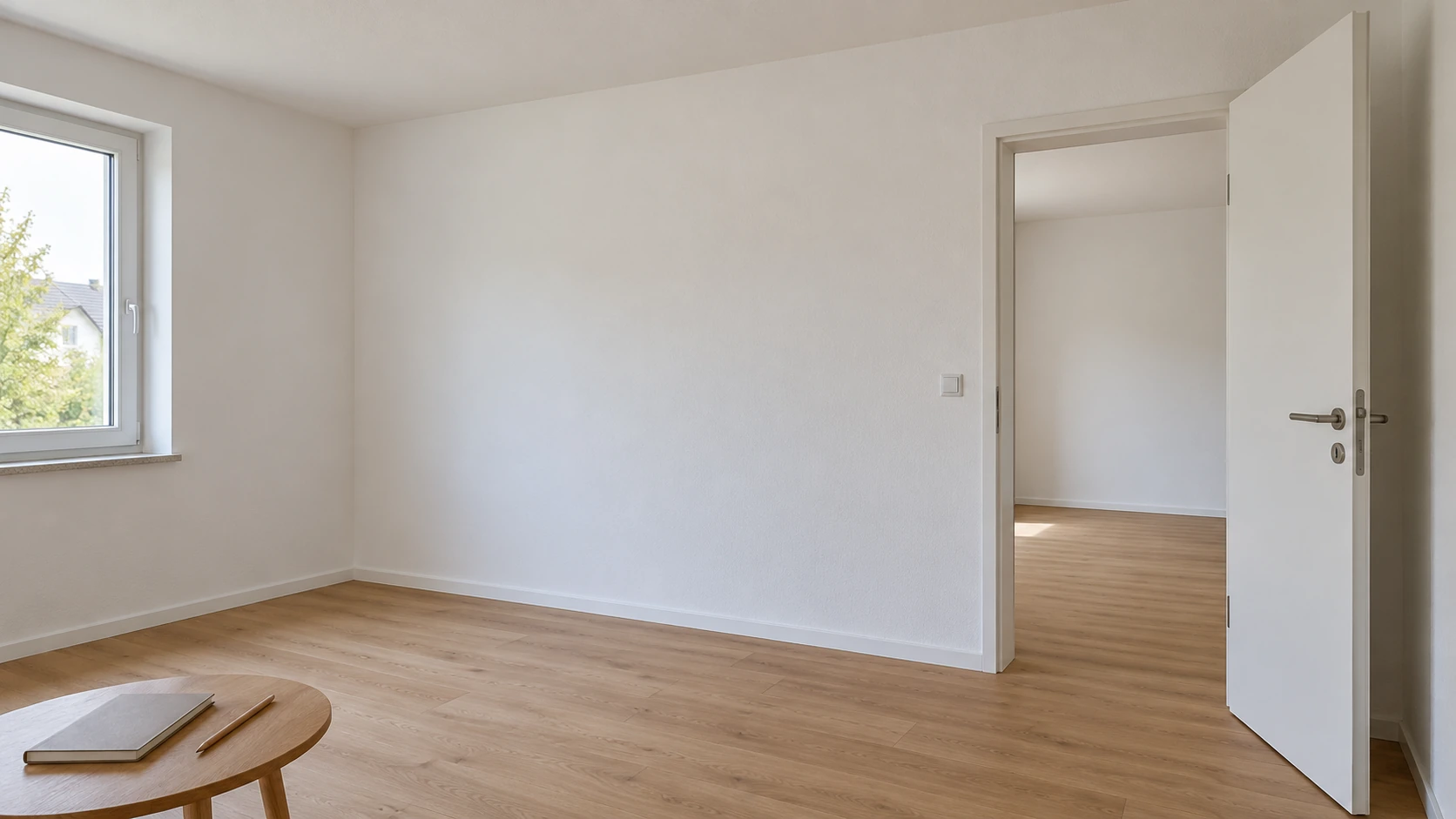
Define the intended result and the removal boundary
For enquiries about removing plasterboard partitions in Wiesbaden and the surrounding area, HandMen provides only online marketing and referral to independent contractors. Begin with the intended result: should the entire partition disappear, should part remain, or is a different layout planned?
Mark the door, frame, glazing, fitted items and surrounding surfaces. Are their removal and replacement included? “Remove the wall” leaves these boundaries unresolved and makes quotes difficult to compare.
The actual construction and its classification as a non-load-bearing wall require professional assessment. A plasterboard surface, tapping sound or estimated thickness does not establish either. This article covers preparation and coordination; it does not authorise changes to load-bearing components.
Record the wall, neighbouring construction and remaining functions
Give the wall an identifier such as R1. Gather layouts, alteration records, invoices and photographs of both faces and their junctions. Clearly mark missing information as unknown. BG BAU C301 identifies investigation of construction, services and hazardous materials as preparation for demolition work.
Non-load-bearing does not mean without a function. Room separation, acoustic or fire protection may remain necessary. Have the consequences for future use and adjacent components assessed. Ownership, tenancy and any authority permissions require case-specific clarification; this checklist provides no general exemption from approval.
| Item | Provide with the enquiry | Have the responsible person confirm |
|---|---|---|
| Wall and scope | Identifier, room sketch and marked removal boundaries | Actual construction, function and scope |
| Documents and history | Plans, construction and alteration records, product evidence | Reliable information and further investigation needs |
| Neighbouring components | Ceiling, floor, side walls and finishes to retain | Junctions, dependencies and making-good requirements |
| Services | Visible connections and known service routes | Affected systems and responsible specialist contractors |
| Materials and unknowns | Known layers, previous findings and information gaps | Investigation required before disturbing materials |
| Permissions and functions | Intended use, existing requirements and permissions | Required approvals, protective functions and evidence |
Assign services and technical systems to appropriate specialists
Record sockets, switches, lighting connections, heating or water pipes and data services on both sides. Include services that might pass through the partition to another room. An apparently empty wall area does not prove that it contains no installations.
Agree who investigates the affected systems, performs any required isolation or rerouting, and confirms the documented condition needed for removal. Assign these tasks to the appropriate specialist contractors. Switching off a room light or removing a cover does not replace that process.
Discuss necessary interruptions and recommissioning directly with those contractors. The removal brief should identify which prerequisites must be satisfied before work starts. This article gives no instructions for disconnecting or testing services.
Investigate unknown materials before dusty disturbance
A newer lining can conceal older layers. Share known alterations and existing material reports as well as the presumed wall construction date. The BG BAU asbestos guide 02/2026 and the UBA publication summary address investigation before disturbing existing building materials.
Ask the appointed professionals what investigation is necessary and who will carry it out. Do not drill, scrape or take samples yourself. A photograph and the description “plasterboard” do not rule out problematic joint fillers, coatings or adjoining materials.
Existing mineral wool also needs a reliable assessment. Section 3 of TRGS 521 addresses information gathering and risk assessment. Unknown insulation should not be declared safe by its colour or an unverified installation date alone. Define investigation and any specialist work as separate tasks.
Agree protection, access and when to pause the affected area
Discuss separation of the work area, protection of existing surfaces, dust control, access and transport routes with the contractor. Agree which rooms remain usable during each stage and who keeps children, pets and uninvolved people outside the work area. These arrangements do not promise dust-free work.
Clarify furniture removal, storage areas and coordination with neighbours or building management. The responsible contractor specifies protective measures and methods for the assessed conditions; a generic plastic-sheet arrangement does not replace that plan.
Unexpected services, unknown layers or different junctions require an identified contact and pause point. Agree that the affected area will not be disturbed further until the responsible professionals have assessed the finding and determined how work may proceed.
Agree separate waste streams and confirmed acceptance
Ask the quote to identify expected waste types, separation, temporary storage, transport and the intended receiver. Contamination or unknown constituents can change the disposal route. Who classifies the materials and confirms acceptance conditions in advance?
Knauf GipsBack describes recycling for suitable, separately collected plasterboard waste under specified acceptance conditions. Coatings and other constituents matter. This is not a promise that every demolition mix will be accepted or that this service is available for your location.
Agree the actual receiving operator, required records and responsibility for changed findings and costs. Mixing contaminated or unresolved materials with ordinary rubble does not make them suitable for a normal recycling route.
Include making good the floor, ceiling and adjoining walls
Removal may leave interrupted flooring, junction strips, differing finishes or open service locations. Establish which components continue through and which finish against the wall. A visible junction does not establish the underlying construction.
Describe the intended end condition of each surface: secured and handed over for further work, or completed with an agreed construction and finish? New coverings and coatings are separate scope items. Colour and material transitions will not automatically become invisible.
Assign making good to the responsible contractor and agree its starting condition and inspection point. IHK classification of drywall construction does not give blanket authorisation for every additional painting, electrical or hazardous-material task.
Put scope, responsibilities and changes into the agreement
Compare quotes for the same documented scope. Attach the worksheet to the enquiry and name the actual contractors and decision points. Agree additional work arising from unexpected findings before it is carried out.
Required permissions and registrations depend on the actual activities and need separate clarification. Kleinunternehmer is a tax status and does not replace that assessment.
HandMen names the specific independent partner and obtains your separate consent before transferring personal data. Agree the visit, survey, technical assessment, design, quote, contract, work, evidence, invoice and payment directly with the contractor. HandMen does not perform the work, supervise construction, issue technical approvals or confirm individual qualifications.
| Package | Agree the result and boundaries | Responsible party and coordination point |
|---|---|---|
| Assessment and permissions | Assessed construction, scope and required permissions | Appointed professional; before final commissioning |
| Materials | Investigation, findings and any specialist work | Responsible specialist; before disturbing materials |
| Services | Investigation, required changes and documented condition | Relevant installation contractors; before removal begins |
| Protection and removal | Work area, protective plan and agreed removal boundary | Removal contractor; before setup and work |
| Waste | Separation, transport, confirmed receiver and records | Named responsible party; before generation and collection |
| Making good | Surfaces, construction, finish and excluded work | Relevant follow-on contractor; before its work begins |
| Checks and documents | Agreed intermediate conditions, evidence and open issues | Appointed assessors or contractors; at specified handovers |
| Changes | Finding, solution, additional scope and costs before execution | Named contracting parties; before continuing changed work |