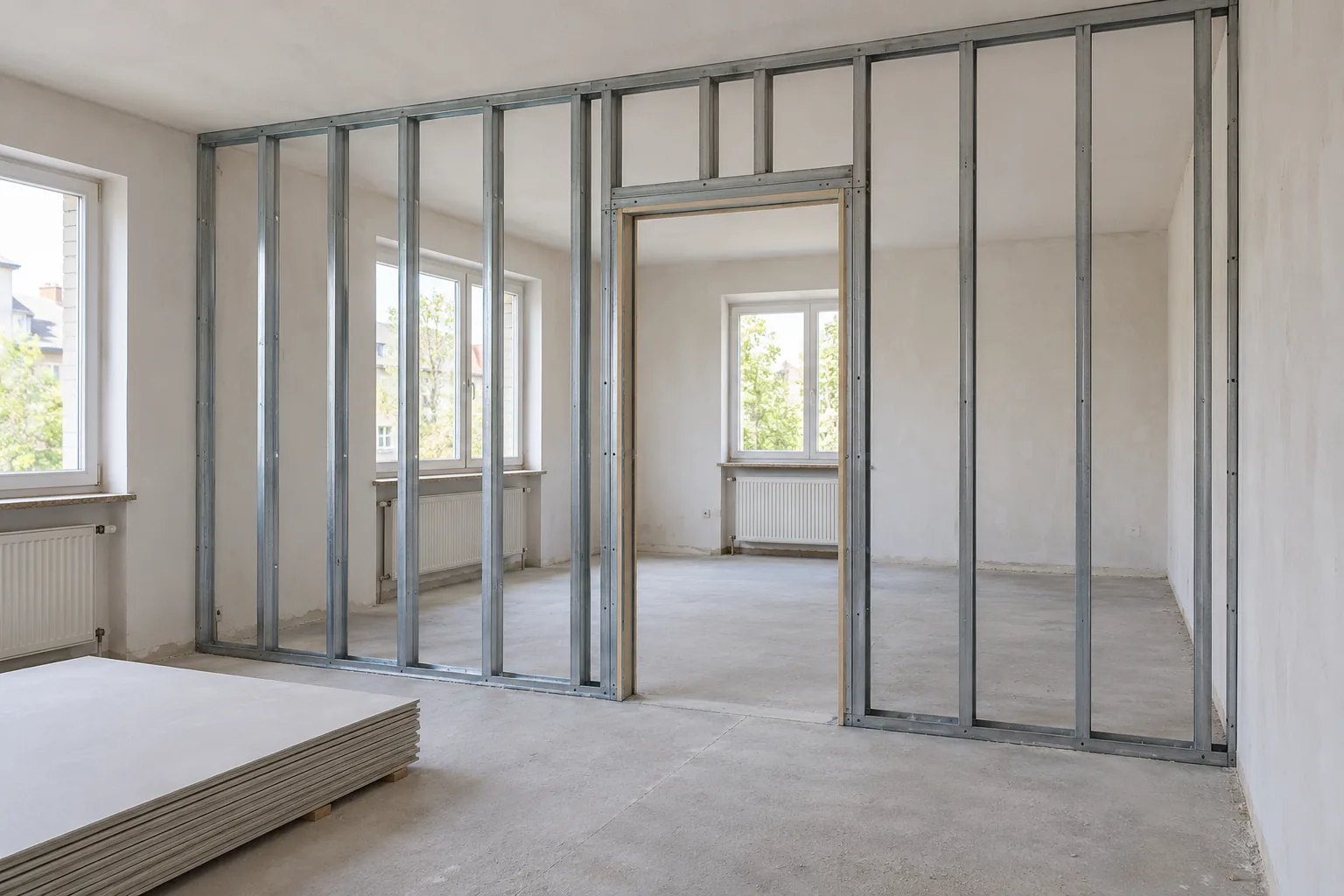

Match boards and accessories to the agreed construction
For enquiries about plasterboard work with a planned board delivery in Wiesbaden and the surrounding area, HandMen provides only online marketing and referral to independent contractors. Agree with the installing contractor which materials belong to the specified wall or ceiling and who orders them.
List the manufacturer, exact product, format, edge type and confirmed quantity. Assign boards to a room or building element. Profiles, fixings, jointing materials and other components need separate entries with their relevant product documents.
A similar colour or an available replacement board does not establish equivalence. If an item is unavailable, have the responsible contractor assess any proposed substitution before ordering or use. Quantities and a shopping list do not replace technical design of the complete assembly.
Record the delivery endpoint, route and contacts
Ask the seller where the promised delivery ends: at an agreed unloading point, the entrance or the named room. Assign unloading, onward transport, stairs and packaging collection explicitly. A delivery date does not automatically include these services.
Provide actual board and package formats and known restrictions along the route. The entrance, doors, stairs, landings and any lift must suit the planned transport. Those responsible for transport assess the method, staffing and equipment; your route description does not approve a transport operation.
| Item | Record | Have confirmed before delivery |
|---|---|---|
| Material list | Articles, formats, quantities, accessories and intended element | Complete order and handling of substitute products |
| Delivery scope | Seller, unloading point and offered transport services | Who unloads, carries onward and handles packaging |
| Transport route | Access, restrictions, floor level and available information | Feasible route and responsible transport contractor |
| Timing and contact | Delivery window, reachable contact and access keys | Readiness to receive goods and response to delay |
| Storage area | Proposed room and known construction conditions | Suitable location, arrangement and professional load assessment |
| Handover | Order records, recipient and unresolved prerequisites | Discrepancy records and contacts authorised to decide |
Organise transport to the storage area and its boundaries
Name who is responsible between the unloading point and final storage area. The site recipient and appointed transport contractor are not necessarily the same person. Agree reachable contacts and an identifiable handover point.
Coordinate access and necessary arrangements within the building beforehand. Routes, doors and required escape paths must remain usable. Include occupants, other contractors and vulnerable finishes in the organisation; the responsible company determines the technical protection and transport solution.
If the route is blocked or the agreed room remains unsuitable, a coordinated alternative is needed. Decide who arranges a changed date or delivery solution. Temporarily available outdoor space is not automatically suitable for intermediate storage.
Have the temporary storage load and location assessed
A delivery concentrates weight within a limited area. Have the proposed storage location assessed professionally against the actual delivery, its arrangement and existing floor construction. An empty space, an undamaged finish or the later use of lightweight assemblies does not establish suitability.
Rigips treats the storage location and floor capacity as connected site questions. Agree suitable support and arrangement for the actual boards with the responsible contractor. Include other stored materials and planned transport in the assessment rather than considering the board stack in isolation.
Record which building or floor information is still missing and who resolves it. Also assign responsibility for preserving surface protection and the confirmed arrangement if other work requires material to be moved. A new storage location needs the same coordination as the original.
Protect material from moisture and damage
Have storage conditions confirmed for the products actually supplied. This includes the room’s condition, protection against water and other work, and treatment of packaging and exposed edges. Packaging alone does not establish the suitability of an arbitrary storage location.
Responsible people must be able to identify changed conditions, such as a leak, wet follow-on work or relocation. Agree how they notify the supplier and installing contractor before affected materials are used.
Accessories may have their own storage and usability requirements. Record these separately from the boards. Flooring delivered at the same time needs its own product instructions; sharing a site does not establish one preparation method for every material.
Coordinate wet processes and actual readiness for installation
Identify planned or ongoing plastering, screeding and other moisture-intensive work. Delivery timing and the start of individual drywall stages must fit the actual site conditions. A date in the calendar does not establish room readiness.
BV Gips Merkblatt 1 distinguishes storage from site-climate conditions. Keep receipt of goods, suitable storage and readiness for boarding or joint filling as separate decisions in the schedule. Neither elapsed days nor an apparently dry surface replaces assessment of the relevant prerequisites.
Agree who assesses and records the required conditions before work starts. Recoordinate delivery and installation after delayed wet work, a room change or questionable material. Independently altering heating or ventilation to accelerate preparation does not establish material suitability.
Compare the delivery and identify questionable materials clearly
Compare the order, delivery note and accessible product markings. Record quantities, missing items and visible concerns such as damaged edges, packaging or moisture traces. Photographs should identify the affected delivery and item.
The arrival check does not replace a complete assessment of material suitability. Agree who resolves discrepancies with the seller and installing contractor. Identify affected materials clearly and do not have them installed without an agreed decision.
Material that later looks dry is not necessarily suitable for use. Have the responsible parties decide what happens next based on the product and observed condition. Record the decision, responsible people and effects on quantities, replacement delivery and the start date.
Assign responsibility from ordering to installation
Material purchase, delivery and temporary storage follow the actual agreement with the seller or installing contractor. Clarify required authorisations and registrations for the commissioned scope; drywall classification does not exempt accompanying work generally. Kleinunternehmer is a tax status and does not waive applicable trade requirements.
HandMen names the specific independent partner and obtains separate consent before sharing personal data. Agree the visit, measurements, technical assessment, design, quote, contract, work, evidence, invoice and payment directly with the contractor. HandMen does not carry out building work, supervise construction, issue technical approvals or confirm individual qualifications.
| Task | Agreed result | Who confirms it, and when? |
|---|---|---|
| Order and changes | Suitable articles, quantities and assessed substitutions | Client and installing contractor; before ordering |
| Delivery and access | Confirmed endpoint and usable transport route | Seller and transport contractor; before arrival |
| Storage area and loads | Assessed location and suitable arrangement | Responsible professionals; before unloading inside |
| Protection and storage | Maintained storage conditions and named contact | Agreed person on site; throughout storage |
| Receipt of goods | Recorded quantities, markings and visible concerns | Named recipient; on delivery |
| Questionable material | Recorded decision for affected items | Supplier and responsible contractor; before use |
| Site readiness | Assessed conditions for the particular work stage | Installing contractor; before starting |
| Schedule changes and records | Agreed revised sequence and traceable handovers | Contracting parties; when plans change and at handover |