Describe the location and the intended result
For enquiries about local repairs to non-load-bearing plasterboard lining in Wiesbaden and the surrounding area, HandMen provides online marketing and referral to independent contractors. Identify the room, wall and visible location. Do you want an old fixing hole closed, an area of damage assessed or a repeatedly cracked joint investigated?
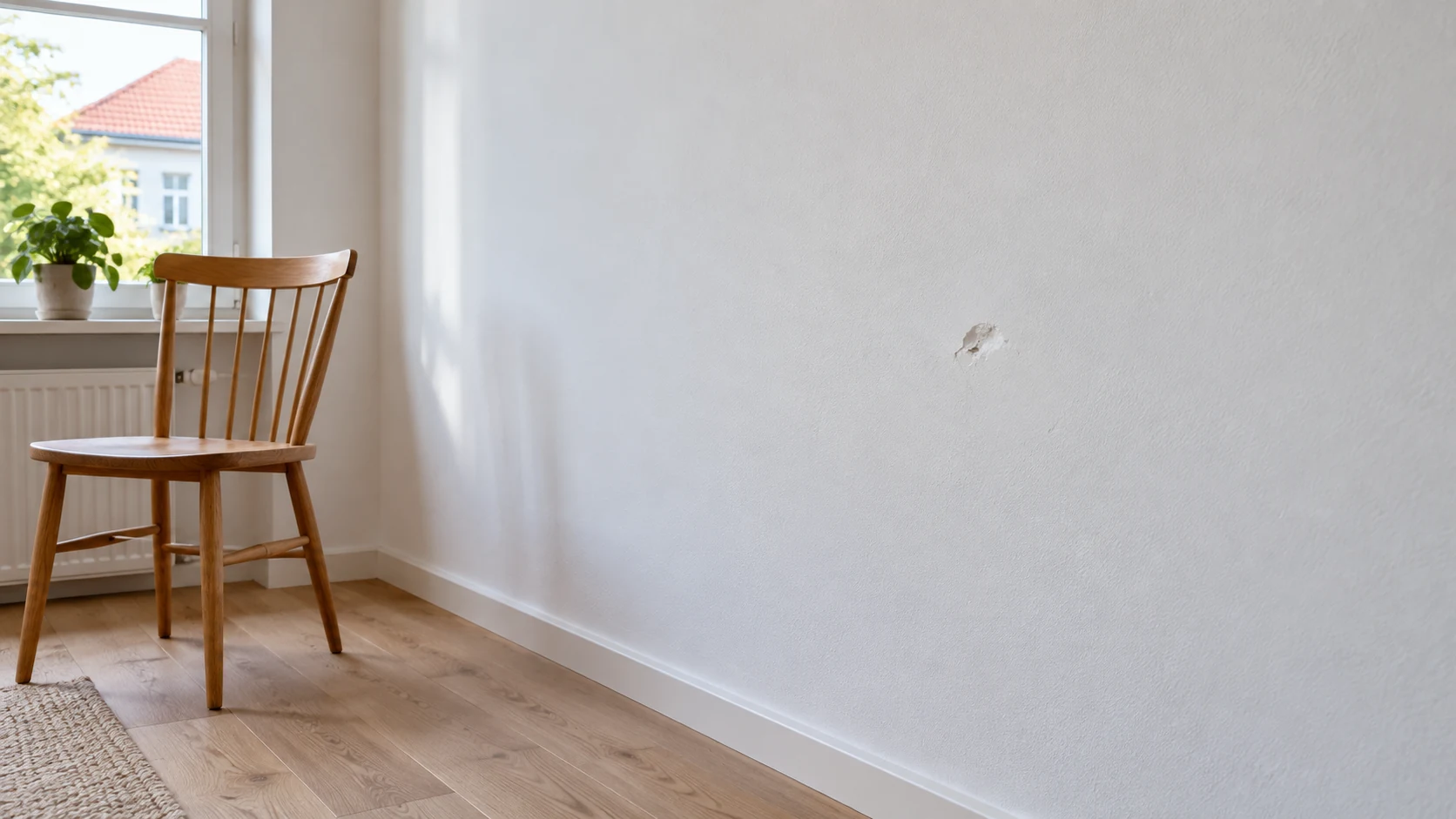
A small hole left after removing an object, an indented surface and a crack at a wall junction present different starting points. Visible size alone does not determine the repair scope. This guide helps you collect observations and open questions for a site visit and request quotes for the same intended result.
Add the future use: will the wall remain clear, will furniture return or is a new fixing planned? Also agree whether the commission covers construction repair alone or a particular finished surface. Closing an old hole does not establish a suitable fixing point for a new object.
Record observations without changing the damaged area
Assign an identifier such as S1 on wall W1. Connect a room photograph, the location on the wall and a close-up of that same spot. Record visible extent, discovery date, known events and previous repairs. Describe what is visible without scraping away layers or enlarging an opening to prepare the enquiry.
For cracks associated with missing separation between components, Rigips calls for the cause to be identified first; simply repairing the joint is insufficient in that situation. Record whether a mark recurs. Timing after a move or earlier work does not, by itself, establish cause or responsibility.
| Visible situation | Record without disturbing it | Clarify with the responsible contractor |
|---|---|---|
| Individual hole | Location, visible extent and known previous use | Affected layers, existing installations and suitable closure |
| Dent or impact mark | Overview, detail and any known event | Extent of damage and necessary repair scope |
| Detached surface | Visible edges and existing coating | Condition of the facing and board, and required preparation |
| Recurring crack | Route, date and previous repairs | Cause and necessary measures before surface repair |
| Crack at a junction | Transition to ceiling, wall, frame or another component | Junction function and an appropriate repair detail |
| Stain or deformation | Location, visible change and known moisture events | Further investigation and condition before closure |
Clarify the existing wall construction and its functions
Collect available plans, invoices, system names and earlier photographs. Is the surface a partition, framed lining or directly bonded plasterboard? Which layers and installations are known? Write unknown where records are missing; tapping the surface or looking at a hole does not replace assessment of the existing construction.
Rigips distinguishes a material’s properties from the fire resistance of the complete construction and refers to system evidence. Have the required protective functions and appropriate repair requirements determined for the existing component. A visually closed patch or an arbitrary repair product does not confirm restored fire performance.
Mark known services, sockets, maintenance points and planned loads. Agree who will assess affected areas and account for installations before any necessary opening. If the surface belongs to a ceiling, roof slope or service shaft, expressly include that location in the assessment; a wall example does not prescribe its repair method.
- Plan a drywall partition: layout, doors and everyday use
- Framed lining before an existing wall: depth, services and junctions
- Direct-bonded plasterboard: substrate, finished wall position and junctions
- Drywall boxing: plan access to concealed services
- Rigips: fire performance of the complete construction (German)
Have moisture signs and unknown old layers assessed first
For stains, deformation or a known leak, include the history in your enquiry. The German Environment Agency notes that mould damage may be concealed. Have unusual areas and possible causes professionally assessed. Light-coloured paint or a new facing does not confirm that a moisture source has been resolved.
BG BAU emphasises building information before interventions where asbestos may be suspected. Provide the building’s age, alterations and available material findings. Before unknown old coatings or filling layers are disturbed, agree who will assess further investigation needs. Taking samples yourself or carrying out sanding trials is unnecessary for preparing this enquiry.
Agree a decision point if further damage emerges during professionally planned preparation. Who receives the findings, confirms extra work and updates dates? In areas exposed to water, affected waterproofing junctions must also be considered. Actual use is more informative than a board’s colour alone.
Separate assessment, repair and the finished surface in the quote
Ask for a clear description: which investigation is included, which findings remain open and on what basis will the repair method be selected? Use the identifiers for affected areas. A price per hole is comparable only when starting conditions, affected layers and the agreed result match.
Ask whether the proposed service covers a local surface correction alone or also board sections, framing, junctions or additional functions. The responsible contractor decides after assessment. Different constructions cannot be covered here by a universal hole-size threshold, material choice or repair method.
Include furniture and floor protection, access, dust control, waste, further appointments and subsequent coating as specific items. Record who agrees additional services before they are commissioned. This makes clear whether a quote reaches the agreed finished surface or ends with a prepared repair area.
Agree appearance and the handover condition
Describe the existing texture, sheen, colour and lighting, together with the intended result. Should work cover only the spot or a larger continuous area? Have the necessary extent assessed and expressly quoted. A locally closed defect does not promise an invisible match to the surrounding colour or texture.
The German Gypsum Industry Association lists separate publications on surface quality, junctions and pretreatment. Agree the filling target and subsequent coating as specific tasks. A Q level alone does not describe a match to an aged surface or establish protective functions or authorisation for general decorating work.
Rigips highlights suitable site conditions and moisture release before joint finishing. Coordinate the next stage according to actual conditions and selected materials. Agree who confirms readiness for further work; a small repair area does not automatically mean that every stage can be completed in one visit.
Record responsibilities and repair documents
Add a contractor, contact and agreed time for each item. Where areas need opening and closing again, agree necessary checks and documentation beforehand. Photographs help trace the work; they do not replace technical evidence or agreed acceptance.
Keep the original observations with the confirmed repair scope and results. Note remaining restrictions, such as outstanding coating or a new fixing that requires separate assessment. If further changes occur, the responsible contractor can refer to the same recorded history.
| Topic | Assign responsibility | Record the result or document |
|---|---|---|
| Damage and timeline | Who records observations and assesses the cause? | Location identifier, photographs, history and findings |
| Construction and functions | Who clarifies the assembly and required protective functions? | System details, documents and open questions |
| Further investigations | Who assesses moisture and unknown old materials? | Investigation needs, suitable specialists and starting conditions |
| Services and loads | Who accounts for services, access and future objects? | Known areas, interfaces and restrictions |
| Repair method | Who determines the appropriate scope and materials? | Confirmed service and necessary evidence |
| Protection and sequence | Who protects the room and coordinates dates? | Preparation, dust controls, waste and work sequence |
| Surface and subsequent work | Who handles preparation and later coating? | Agreed appearance and handover condition |
| Checks and changes | Who checks, documents and coordinates new findings? | Inspection points, changes and remaining tasks |
Agree the actual scope with the independent provider
IHK Frankfurt distinguishes system-based acoustic and dry construction using prefabricated components from essential activities of Annex A crafts. This does not create a general exemption for every repair, coating or preparatory task. The actual commission matters; clarify the intended contractor’s appropriate authorisation and required expertise.
Painters and decorators and electrical contractors appear in Annex A of the German Crafts Code. The small size of an area or Kleinunternehmer tax status does not replace required craft authorisation. Describe general decorating, electrical work and other trades separately so responsibility matches the commissioned scope.
For an enquiry in Wiesbaden and the surrounding area, begin with location identifiers, photographs, available records, history and the intended result. HandMen names the specific independent partner and obtains separate consent before transferring personal data. You agree the site visit, technical assessment, design, quote, contract, work, invoicing and payment directly with that provider. HandMen handles marketing and enquiry referral, not repair execution, site supervision or technical approval.
- IHK Frankfurt: acoustic and dry construction (German)
- German Crafts Code: Annex A (German)
- How HandMen works: enquiry, contract and invoice
- Prepare an enquiry to assess plasterboard damage
- Wallpaper on plasterboard: substrate, covering and handover planning
- Plasterboard: plan edge protection, corners and the finished surface